Quantum Again?
- Apr 22
- 3 min read

When I write, I often try to come up with two topics that are linked in some interesting way, and find it fun when the link is unexpected or particularly tenuous. The more unexpected the connection, the more fun it can be, particularly when I learn about something new.
So, the first time I wrote about quantum computers and encryption, I discovered the band Mammút, through finding their song “Shore” while searching for more information about Shor’s algorithm. Then, a few months later, I wrote about quantum hype and BS, through an article which connected quantum computing to a VIC-20, an abacus, and a dog.
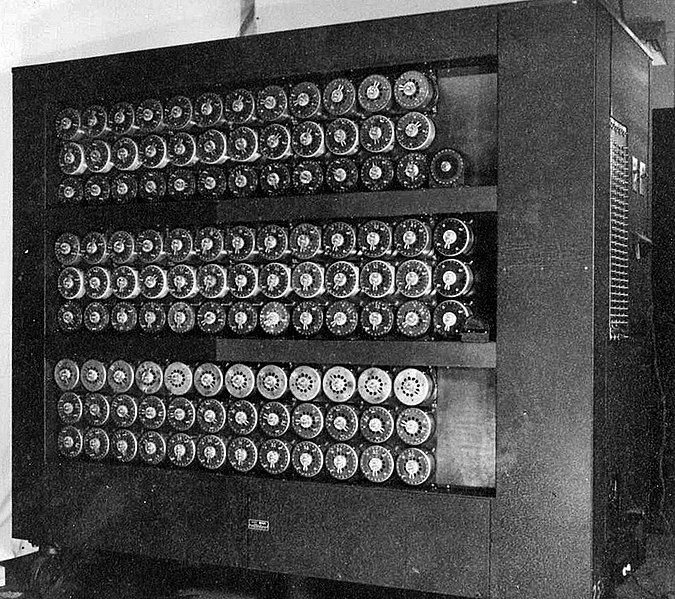
Then, I connected bombes and bombs, to illustrate the fact that we won’t necessarily know about breakthroughs in quantum computing as soon as they happen, because governments have strong incentives to keep such breakthroughs secret for as long as possible.
And now, quantum computing is in the news again.
Sigh.
I wanted to come up with a connection, but all I could think of was the TV series Quantum Leap (1989), which I remember liking, but not much more. Or maybe the 2022 revival, which I may yet see? And, while “scraping the barrel” can be fun, I was not really “feeling” it.
And, then I found the sculpture!
It’s called The Quantum Leap, and it’s located in Shrewsbury, Shropshire, England, on the bank of the River Severn. It’s an abstract work, created to celebrate the 200th anniversary of the birth of Charles Darwin. It looks like a blend of a spinal cord and a Slinky, and there appears to have been a major scandal around the cost of the work, which exceeded £1 million.
Aside from it being something new to learn about, it gives me a way to come back to quantum computing!
But why? What’s going on this time?
The big news is that Google has moved up their timeline for implementing post-quantum cryptography (PQC) to 2029, from a prior target of 2035. While this covers a lot of work across a great many products, it all boils down to replacing existing encryption schemes with updated ones which are considered resistant to quantum computers.
For a high-level summary, current encryption can be broken into symmetric (where the encryption and decryption keys are the same) and asymmetric (where the encryption and decryption keys are different). Quantum computers are expected to be somewhat more effective at “breaking” current symmetric encryption schemes, but the improvement is not expected to be dramatic.
On the asymmetric side, however, quantum computers will be able to use something known as Shor’s algorithm to calculate the factors of large numbers much more quickly than traditional computers. For context, when you increase the length of a password, the increase in difficulty “breaking” asymmetric encryption increases exponentially for traditional computers, but only increases linearly for quantum computers. In practice, this means that keys which are effectively “unbreakable” will become essentially useless.
And, because many actors are simply grabbing and storing data for later decryption, the risk is highly dependent on the “half-life” of the data being protected. If your data is essentially useless after a year, you just need to be “quantum-ready” a year before quantum computers are viable.
But no one actually knows when that will be, so the smart strategy is to move as soon as possible, to minimize the impact of your data exposure once quantum computers are available.
So, does Google’s news mean that quantum computers are here?
Um, no. Not really.
Instead, Google appears to be reacting to a number of news stories and studies which demonstrate that Chinese researchers are advancing quickly and have made steps which, while incremental in nature, are important ones toward practical quantum computers.
It appears that the Chinese are not only investing heavily and advancing quickly, but also appear to be taking innovative approaches which may lead to more efficient ways of addressing a number of challenges.
Is Google overreacting, then?
I would say no. Not really.
As I described before, we know that governments are investing heavily in quantum computers, and we know that they are very unlikely to inform people once viable quantum computers are available, and we know that China, in particular, is investing heavily in their development.
The safest bet is to assume that quantum computers are already in play, and that we should be focused on moving to post-quantum cryptography as quickly as is feasible, depending on the half-life of your data. So, if you are storing data which will still be relevant years from now, it may already be too late.
But that doesn’t mean you need to panic, though you should assume that quantum computers will exist for some time before we are generally aware of them. Just understand your risk, and plan accordingly.
Cheers!


kết quả bóng đá nét mình thấy bạn bè nhắc hoài nên tối qua rảnh rỗi vào thử xem sao. Mình không phải kiểu canh kèo hay ngồi theo dõi từng giải, chủ yếu muốn coi trang trình bày có dễ nhìn không thôi. Vừa vào là thấy phần livescore chạy liên tục, bảng tỷ số dạng cột nhìn gọn, liếc nhanh là biết cặp nào đang đá và tỉ số hiện tại. Mình cũng để ý họ tách riêng mục “nhận định bóng đá hôm nay” thành từng khối, có tiêu đề với thời gian đăng rõ ràng nên không bị lẫn vào phần kết quả. Kéo xuống dưới vẫn là bảng realtime với cột “Chủ Tỷ số Khách”…
xosoplus.com dạo này thấy bạn bè nhắc hoài nên mình cũng bấm vào coi thử cho biết. Mình không đọc kỹ nội dung đâu, chủ yếu xem giao diện có dễ nhìn không thôi. Cảm giác đầu tiên là trang làm khá gọn, khoảng trắng vừa đủ nên nhìn đỡ bí, không bị nhồi chữ. Mấy mục được chia theo nhóm rõ ràng nên mình lướt một chút là biết đang ở phần nào, khỏi phải bấm tới bấm lui nhiều. Trên điện thoại thao tác cũng ổn, menu đặt chỗ dễ thấy nên chuyển trang nhanh. Mình thích kiểu họ trình bày theo từng khối thông tin, các ô canh thẳng hàng nhìn rất “ngăn nắp”, kéo xuống là…
keonhacai5.net bữa trước mình thấy bạn bè nhắc qua nên tò mò vào lướt thử cho biết, chủ yếu xem họ bố trí trang thế nào thôi. Vừa mở ra là thấy giao diện khá thoáng, chia khối nội dung nhìn gọn nên không bị rối như mấy trang toàn chữ liền tù tì. Mình cũng để ý cái menu đặt chỗ dễ thấy, bấm qua lại mấy phần nhanh, dùng điện thoại vẫn ổn chứ không phải zoom tới zoom lui. Lướt xuống một chút là bắt nhịp được ngay vì thông tin xếp theo dạng bảng cột nên nhìn cái là hiểu, không cần đọc kỹ từng dòng. Nói chung mình chỉ xem sơ sơ vậy mà thấy…
thập cẩm tv dạo này mình thấy có người nhắc tới khi nói về các nền tảng giải trí trực tuyến nên cũng thử mở vào xem cách họ bố trí giao diện ra sao. Mình không đi sâu vào nội dung hay từng trò cụ thể, mà chủ yếu quan sát cách các chuyên mục được phân chia trên trang và cách thông tin hiển thị cho người dùng. Nhìn tổng thể thì các khu như thể thao, casino, game bài hay slot thường được sắp xếp theo từng nhóm khá rõ, hiển thị dạng khối và danh sách nên lướt qua cũng dễ theo dõi. Các bảng dữ liệu được trình bày dạng cột khá gọn, giúp quan…
rophim hôm trước thấy mấy đứa bạn share nên mình ghé thử cho biết thôi. Vào cái là thấy trang tải khá nhanh, không bị mấy hiệu ứng rườm rà che hết nội dung nên nhìn phát nắm được luôn. Mình thích kiểu họ để bố cục gọn gàng, lướt xuống là gặp các khối phim xếp rõ ràng, tìm theo mục cũng không phải căng mắt. Thử bật một phim thì chất lượng hình ổn, kiểu HD xem trên điện thoại vẫn nét, chuyển qua lại giữa các mục cũng mượt. Nói chung cảm giác dùng giống như họ ưu tiên cho mình thấy phim ngay, chứ không bắt bấm nhiều bước. Điểm mình để ý nhất là phần…